Reptiles and amphibians
Study suggests Spinosaurus lived mostly underwater
Researchers used machine learning and wartime statistical models to evaluate ancient skeletal data, revealing highly aquatic habits in the predatory dinosaur.
Reported by ScienceDaily · · 1 min read
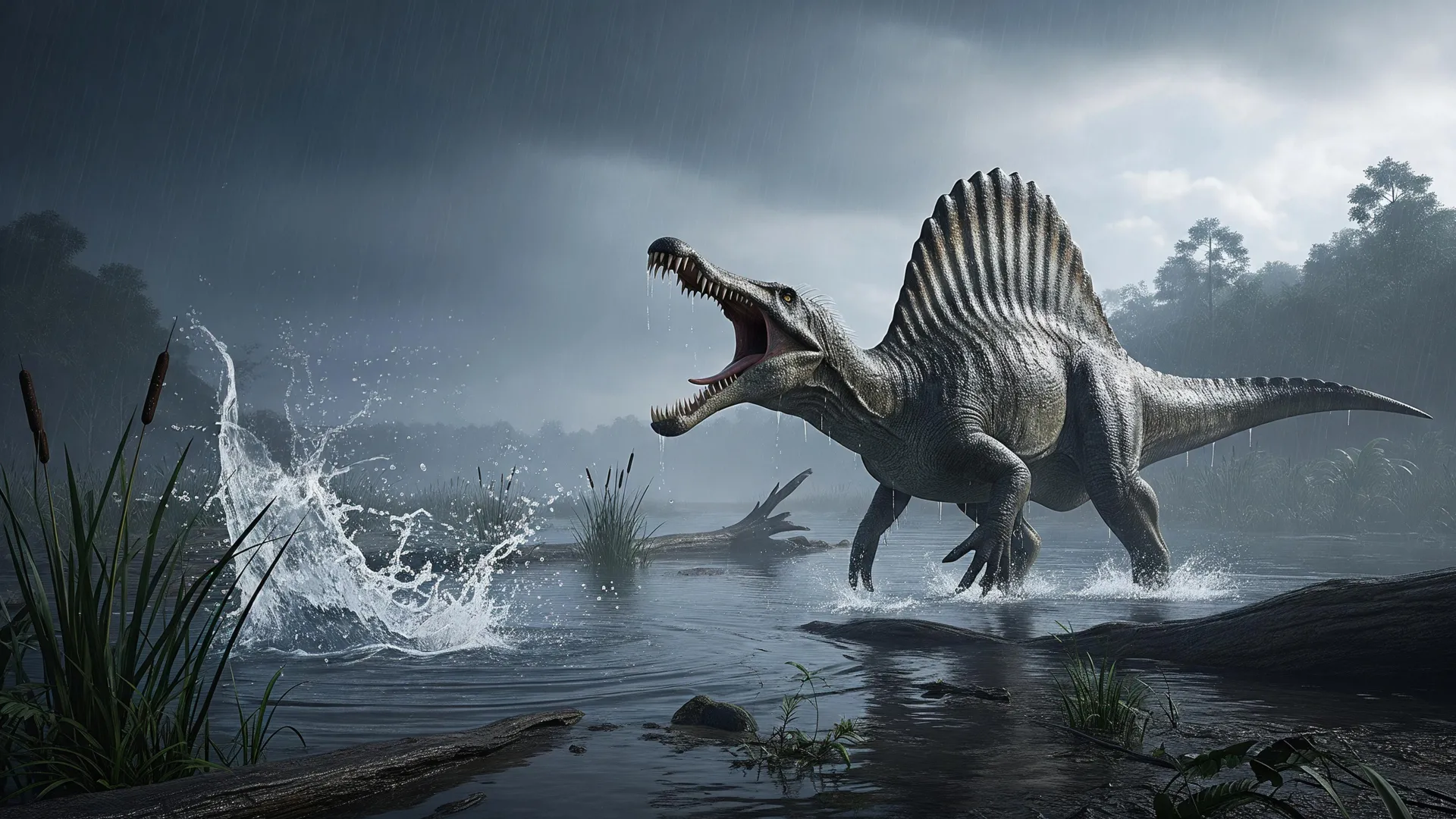
A newly developed computational analysis indicates that the predatory dinosaur Spinosaurus spent most of its existence submerged underwater rather than hunting along shorelines. The investigation, published in Current Biology, provides fresh insight into long-debated habits of the enormous creature, which roamed northern Africa roughly 113 to 94 million years ago.
Paleontologists have spent decades arguing over how the animal functioned. While some experts viewed it as an active submerged predator akin to modern penguins or seals, others maintained it stalked shallow waters like a giant heron. By evaluating anatomical measurements alongside living species, the latest study strongly reinforces the interpretation that Spinosaurus was predominantly submerged.
To reconstruct prehistoric lifestyles, the scientific team examined hundreds of specimens, collecting over 11,000 measurements alongside digital scans and photographs from global museum collections. They fed this information into machine learning algorithms paired with a wartime statistical method originally designed to assess radar blips for enemy aircraft. Their computational modeling successfully forecasted soft-tissue flippers and swimming habits with greater than 90 percent accuracy.
The investigation also evaluated mesosaurs, miniature ocean-dwelling reptiles from 290 to 274 million years ago whose remains occur in South Africa and South America. Although their live births previously led some scientists to assume an exclusively aquatic existence, their limb dimensions show they regularly crawled ashore, resembling modern platypuses or alligators.
The researchers concluded that no Paleozoic sea reptiles ever cut ties with dry land entirely, as every species before the dinosaur era retained amphibious habits. According to study leaders at Yale University, this mathematical framework removes subjectivity from fossil evaluations and may soon help analyze other evolutionary milestones, including upright walking and the origins of flight.