Birds
Tagged shorebird completes trek from England to Siberia
A tiny tracking device revealed the full migration route of a bar-tailed godwit navigating thousands of miles along international wetland corridors.
Reported by The Guardian · · 1 min read
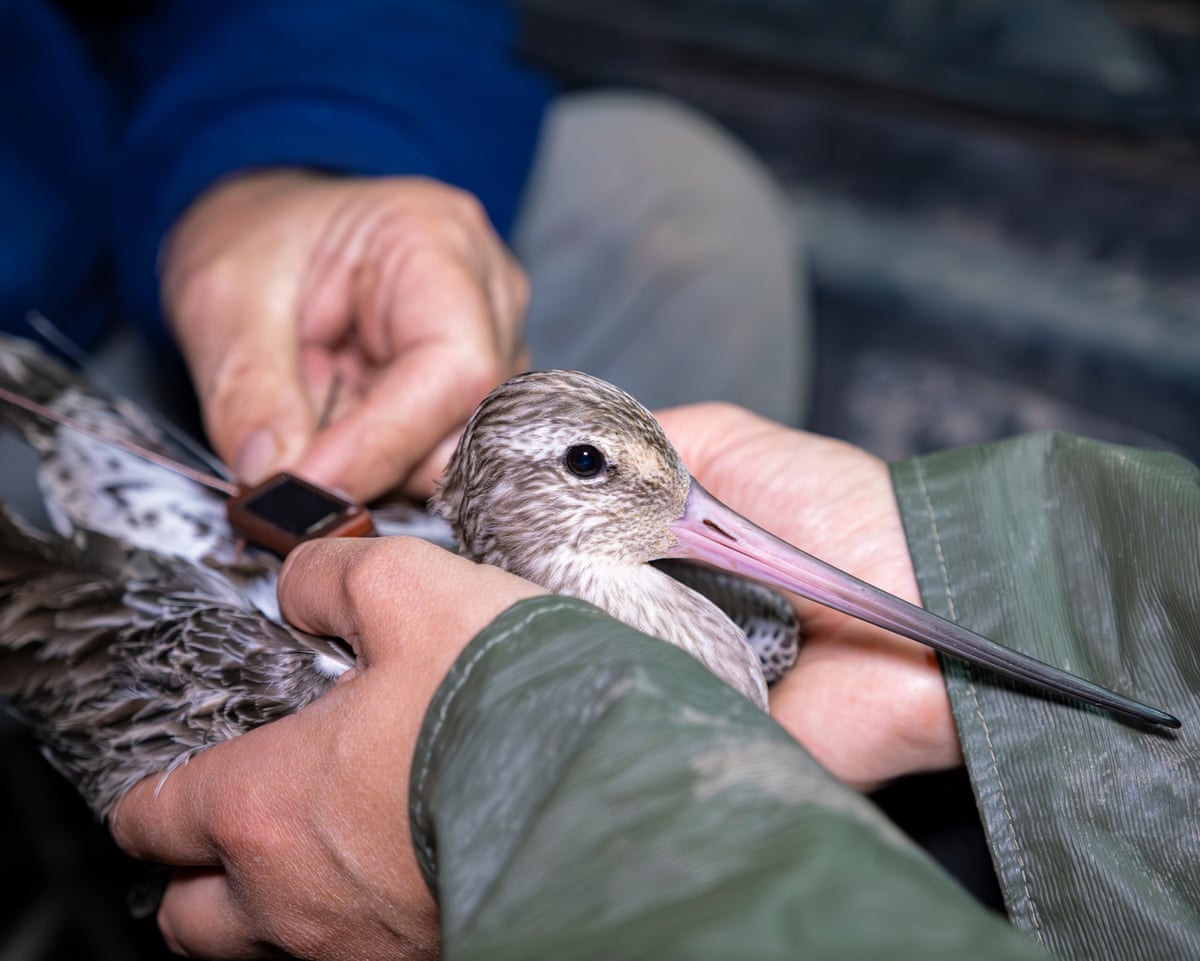
A bar-tailed godwit equipped with a miniature transmitter has successfully navigated a round-trip expedition measuring 6,800 miles between eastern England and northern Russia. Researchers were able to record the bird's complete migration path for the first time, highlighting the species' remarkable stamina as it traversed diverse geographic zones.
Bar-tailed godwits, which are slightly bigger than common pigeons, hold global records for continuous non-stop avian flight. Members of the species frequently spend warmer months nesting across high-latitude Arctic territory, later heading toward temperate British marshes when colder conditions arrive.
Conservation specialists from the Royal Society for the Protection of Birds, working alongside the Wash Wader Research Group, attached a six-gram sensor to the male godwit, nicknamed Phil, in January. The tag took its name from longtime research coordinator Phil Ireland. Following months of continuous data transmission, the device monitored the bird's departure eastward through Dutch, German, and Danish shorelines before reaching Siberian nesting grounds by late spring.
During his return southward, Phil flew over polar waters near northern Scandinavia, briefly resting on several isolated Norwegian islands prior to re-entering the Wadden Sea. He ultimately touched down in Norfolk at the RSPB Snettisham reserve, an estuarine haven where enormous flocks congregate during extreme tides.
Coastal expert Jeff Kew noted that witnessing an individual animal return safely after traveling such vast distances underscores the necessity of coordinated international preservation. Because migratory waders cross multiple borders, safeguarding a linked chain of healthy wetlands remains essential to their ongoing survival.
These shorebirds rely on the East Atlantic flyway, an expansive transit corridor connecting polar latitudes with southern Africa utilized by millions of wandering birds annually. Mudflats surrounding the Wash serve as a crucial nourishment depot along that pathway. Ornithologist Dr. Nigel Clark explained that observing tagged individuals demonstrates how closely local reserves interact with broader international travel routes, proving that interlinked habitats matter far more than isolated individual stops.