Reptiles and amphibians
Forgotten fossil reveals new clawed dinosaur
A century-old museum specimen from Britain provides the first proof that megaraptoran predators once lived in Europe before spreading south.
Reported by ScienceDaily · · 1 min read
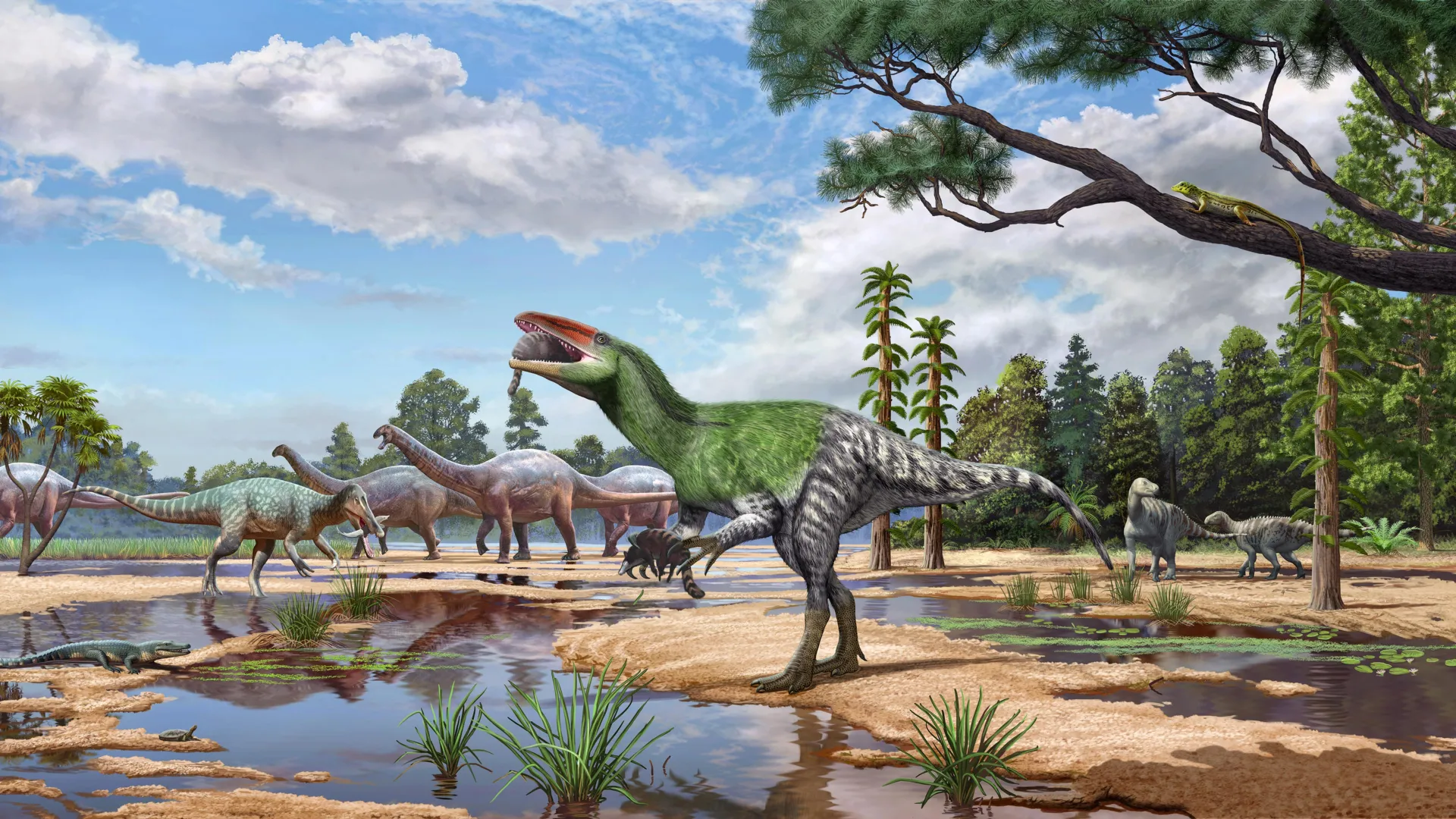
A skull fragment stored inside a museum drawer for nearly a century represents an undiscovered species of predatory dinosaur, scientists report. The creature lived roughly 120 million years ago across what is modern Britain, measuring comparable in bulk to a large tiger and wielding prominent curved talons.
Led by investigators from University College London, the research team published their findings in the journal Royal Society Open Science. They identified the fossil as Invictibellatrix amberina, establishing the earliest confirmed European member of megaraptorans, an enigmatic lineage of carnivorous theropods closely allied with tyrannosaurs.
Unlike massive-jawed hunters such as Tyrannosaurus rex, megaraptorans relied on slender skulls, muscular forelimbs, and large claws to grasp their targets. Dr. Cassius Morrison, the lead author from UCL, noted that the creature stood slightly over 1.5 meters tall and reached three to four meters in length. He explained that it likely had plumage, possessed claws spanning 10 to 20 centimeters, and hunted small dinosaurs, lizards, and ancient mammals.
The discovery also resolves a lingering puzzle regarding how megaraptorans migrated across prehistoric landmasses. Paleontologists previously theorized that these carnivores originated in Asia and traveled across Europe to reach the southern supercontinent Gondwana, but physical proof within Europe had remained absent until this specimen was recognized.
Researchers analyzed the cranial fragment using computed tomography scans, producing three-dimensional models of both the bone and the braincase cavity. Unique skeletal characteristics, including an oval opening linking the spinal cord and an hourglass-shaped crest, distinguished the specimen from known two-legged predators.
The bone was initially gathered by amateur collector Reginald Walter Tooley along the Isle of Wight shoreline before entering the Natural History Museum in 1924. Co-author Professor Paul Barrett emphasized that the identification underscores the importance of archived museum holdings, where significant evolutionary evidence can remain unnoticed for decades.